
War - AI - New IPOs
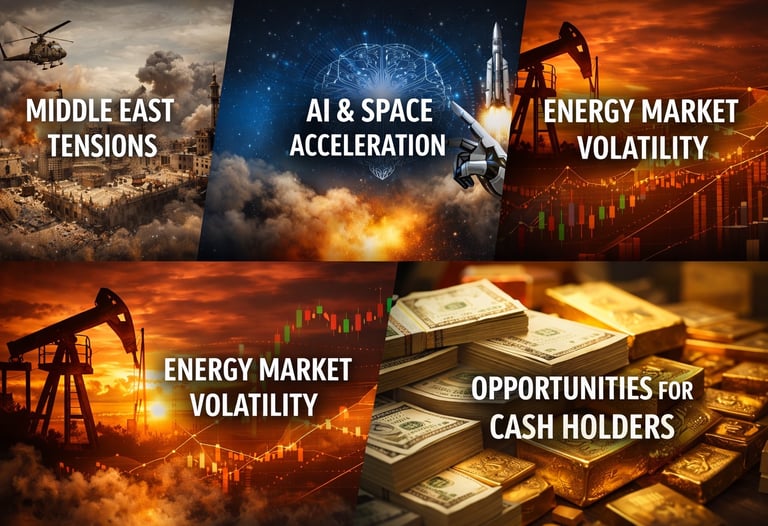
Middle East instability, AI and space acceleration, energy volatility, inflation pressure, outsized opportunities for cash holders
3/5/202610 min read
MACRO RESEARCH NOTE
Geopolitical Risk Re-Pricing and the New Energy Volatility Regime
A Framework for Navigating Markets Under Iran-U.S.-Israel Conflict Escalation
March 5, 2026 | Ulaş Atılgan | Personal Macro Research |
Executive Summary
The resumption of active hostilities between Iran, the United States, and Israel in early 2026 marks a structural inflection point for global macroeconomic conditions. This note outlines my core theses regarding energy markets, inflation dynamics, regional trade disruption, and equity market implications — drawing upon both quantitative indicators available as of March 5, 2026 and a long-standing qualitative familiarity with Middle Eastern geopolitics developed through academic study of International Relations and two decades of market observation.
The central argument is threefold: (1) energy markets are entering a period of elevated structural volatility that will compress risk premia across multiple asset classes; (2) the conflict is unlikely to resolve quickly or decisively in favor of any single party, given Iran's asymmetric defense capabilities and the strategic importance of the Strait of Hormuz; and (3) disciplined investors who maintain substantial cash reserves and emotional resilience will find generational buying opportunities in high-quality technology equities during peak fear episodes.
I. Energy Markets: Structural Volatility and the Buffett Thesis on Oil
1.1 Entering a New Volatility Regime
Brent crude, which traded in the $72–$80/bbl range throughout much of late 2025, now faces a fundamentally altered supply-risk environment. The resumption of direct military engagement involving Iran — the world's seventh-largest crude producer at approximately 3.4 million barrels per day — introduces a supply-disruption risk premium that consensus models have systematically underpriced. Options markets have already begun reflecting this, with crude oil implied volatility (OVX) spiking above 50 in recent sessions, levels last observed during the 2020 Saudi-Russia price war.
The Strait of Hormuz remains the single most consequential maritime chokepoint in the global energy system. Approximately 21 million barrels per day — roughly 21% of global petroleum liquids consumption — transit this 33-nautical-mile passage. Any meaningful interdiction, even temporary, would create immediate inventory drawdowns across OECD nations, whose strategic petroleum reserve (SPR) capacity has been materially reduced following the 2022 emergency releases. The U.S. SPR currently holds approximately 370 million barrels, down from a peak of 727 million barrels in 2009, providing a shallower buffer than in prior conflict cycles.
1.2 The Buffett Energy Thesis: Occidental and Chevron as Core Beneficiaries
Warren Buffett's sustained accumulation of Occidental Petroleum (OXY) — Berkshire Hathaway now holds approximately 28% of OXY's outstanding shares, alongside $10 billion in preferred equity — reflects a structural conviction that oil prices would ultimately reprice higher in a world of chronic underinvestment in upstream capacity. This thesis, which appeared premature during 2023–2024 as oil traded rangebound, is now being validated in accelerated fashion.
The case for OXY is straightforward from a cash flow perspective: at $90/bbl Brent, Occidental generates roughly $5–6 billion in annual free cash flow (FCF) on current production of approximately 1.2 million boe/day. At $100/bbl — a scenario increasingly within the distribution — FCF approaches $8 billion, implying a FCF yield near 10% at current market capitalisation. Chevron (CVX), with its more diversified integrated structure and $15+ billion annual buyback program, offers a more defensive expression of the same theme. Both names should see significant positive earnings revisions in upcoming quarters as the forward strip re-anchors at higher levels.
Disclosure: I hold long positions in OXY and CVX entered prior to the current escalation. This should be read as context, not recommendation. — Ulaş Atılgan
II. Inflation Dynamics: A Transitory Spike, Not a Structural Return
2.1 Near-Term Inflationary Pressures
The transmission mechanism from energy prices to headline CPI is well-understood but often underestimated in its speed. A sustained $20/bbl increase in crude prices — consistent with current futures backwardation structure — historically adds approximately 0.8–1.2 percentage points to U.S. headline CPI within two to three months, primarily through gasoline, diesel, and petrochemical inputs into goods prices. With February 2026 U.S. CPI already running at 3.1% year-over-year (above the Fed's 2% target), this supply-side shock arrives at a structurally inconvenient moment.
The European picture is arguably more acute. The Eurozone's dependence on Middle Eastern crude remains elevated — approximately 18% of EU crude imports originate from the Gulf region — and the EU has limited domestic energy substitution capacity in the near term. European gas markets, which had stabilised following the post-2022 restructuring of supply chains, face renewed upside pressure as LNG re-routing creates freight market stress. ECB swap-implied inflation expectations for the 2026–2027 window have already moved 30–40 basis points higher in recent weeks.
Both the Federal Reserve and the ECB are therefore likely to maintain their current pause on rate reductions, which had been tentatively pencilled in for Q2 2026. A re-acceleration to 4.0%+ headline CPI in the U.S. by Q3 2026 cannot be excluded under a sustained conflict scenario.
2.2 Ceasefire Scenario: Gradual Disinflation
However, it is critical to distinguish between supply-side and demand-driven inflation in assessing the durability of this episode. If a ceasefire is achieved — even a partial, contested one — the energy risk premium embedded in crude prices will deflate relatively quickly. Historical analogues (Gulf War I resolution in 1991, the unwinding of the 2022 energy spike following ceasefire proposals) suggest that Brent could retrace $15–20/bbl within 6–8 weeks of a credible cessation of hostilities. This would reduce CPI by a commensurate magnitude, restoring the disinflation trajectory that was in place through mid-2025.
My base case is therefore: elevated but time-limited inflation pressure in the U.S. (peak ~3.8–4.2% CPI, H2 2026) and Europe (peak ~4.0–4.8%), followed by a gradual return toward target as ceasefire conditions are negotiated. The risk to this scenario is a prolonged conflict — addressed in Section IV below.
III. Regional Trade Disruption: From the Gulf to Northeast Asia
3.1 The Gulf Business Ecosystem Under Stress
The conflict carries severe implications for the Gulf Cooperation Council's (GCC) non-oil economic model. Dubai's economy, which has successfully diversified toward finance, logistics, real estate, and tourism — non-oil GDP now represents over 95% of Dubai's total economic output — is deeply exposed to regional stability risk. The DIFC financial corridor, home to 5,000+ registered companies and over $6 trillion in assets under management facilitated through the emirate, is already experiencing capital outflow pressure as global institutional investors reprice Gulf risk.
Qatar faces a dual challenge: as both a major LNG exporter (benefiting from higher prices) and a key regional hub for diplomacy and transit commerce, Doha must navigate between economic windfall and geopolitical exposure. Qatar's sovereign wealth fund (QIA), with approximately $450 billion in AUM, will likely deploy capital defensively, reducing near-term risk appetite in global equity allocations. The knock-on effects for European asset markets — where QIA is a significant investor in real estate, infrastructure, and equities — should not be underestimated. Iranian chaos does not stay contained within Iranian borders; it radiates outward through every supply chain, financial linkage, and diplomatic channel that has been painstakingly constructed across the region over the past two decades.
3.2 East Asian Supply Chain Exposure
For export-oriented economies in Northeast Asia, the Strait of Hormuz is not an abstract geopolitical concern — it is a logistical artery. South Korea imports approximately 70% of its crude oil from the Middle East, with a significant portion transiting Hormuz. Japan's dependency is comparable at roughly 90% of crude imports from the Gulf region. A sustained disruption would force immediate activation of emergency oil stocks under IEA protocols — South Korea maintains approximately 180 days of strategic reserves — while simultaneously pressuring the Korean won and Japanese yen through current account deterioration.
Korean industrial conglomerates (chaebols) with significant Middle Eastern project exposure — Samsung Engineering, Hyundai E&C, and SK Group operate billions in GCC infrastructure contracts — face both project disruption risk and counterparty credit risk. This creates idiosyncratic headwinds for the KOSPI that are distinct from the global equity risk-off dynamic. I watch Korean industrial names with particular attention as a leading indicator of regional economic stress.
IV. Conflict Assessment: Why This Is Not Gaza
Having studied International Relations with a focus on Middle Eastern geopolitics, and having closely tracked Iranian strategic doctrine for over two decades, I hold a strong conviction that the current conflict will not follow the template of previous U.S. or Israeli military operations in the region.
Iran is not Hamas. It is not the Taliban. It is a sovereign state of 87 million people, with a defence industrial base that has been specifically engineered over 40+ years to deny adversaries the ability to achieve rapid, decisive victory. Iran's asymmetric capabilities — ballistic missile arsenals exceeding 3,000 units, Shahab and Fattah-series precision-strike systems, extensive proxy networks in Iraq, Yemen, Lebanon, and Syria, and significant cyber offensive capacity — create a conflict environment where military escalation produces no clean endgame for any party.
The United States has neither the political appetite nor, arguably, the military positioning to achieve the full spectrum elimination of Iranian defence capabilities within any operationally meaningful timeframe. The lessons of Iraq (2003) and Afghanistan (2001–2021) remain institutionally present in U.S. strategic planning. What is feasible is sustained degradation of specific capabilities — nuclear sites, IRGC command infrastructure, naval assets — but this falls well short of the decisive military resolution that financial markets appear to be partially pricing.
When a ceasefire eventually materialises, the terms of that negotiated settlement — what each party conceded, what each extracted — will determine the durability of any subsequent market relief rally. A poorly structured ceasefire that leaves core Iranian strategic interests unaddressed will produce a shorter and shallower recovery than markets currently assume. I expect the conflict to extend beyond most consensus timelines, with meaningful military activity persisting through at least Q3 2026 under the base case.
V. Equity Market Strategy: Aggression at Peak Fear
5.1 The Opportunity Architecture
Paradoxically, the period of maximum market fear may represent the most significant equity accumulation opportunity in a decade. This is not contrarianism for its own sake — it is the logical consequence of the following structural argument: the companies most likely to dominate the next decade of economic value creation (large-cap AI infrastructure plays) are being temporarily mispriced because of a macro risk that is, by definition, finite and reversible.
Microsoft (MSFT), Amazon (AMZN), and Meta (META) — each of which is now generating substantial and growing free cash flow alongside aggressive AI-related capital expenditure — will emerge from this conflict period with their competitive positions intact or strengthened. Microsoft's Azure AI revenue run rate exceeded $13 billion annualised as of Q4 2025. Amazon Web Services' operating income surpassed $40 billion in FY2025. Meta's AI-driven advertising efficiency gains continue to drive EBITDA margins above 45%. These are not speculative vehicles — they are mature cash generators investing aggressively in a structural productivity revolution.
My tactical framework is explicit: during the period of extreme fear — specifically, when the VIX trades above 40 and investment-grade credit spreads widen beyond 150bps — these names should be purchased aggressively in tranches. Emotional control and pre-committed capital allocation rules are the alpha in this environment. The investor who arrives at peak fear with cash reserves and a pre-written buy list will substantially outperform the investor who responds reactively.
5.2 AI Capex: Temporarily Overshadowed, Not Derailed
It is worth acknowledging that AI investment narratives may experience a temporary derating relative to the extraordinary valuations assigned in 2024–2025. Geopolitical risk-off environments historically compress long-duration growth multiples — and AI-adjacent names have been trading on 5–10 year DCF assumptions that are inherently sensitive to discount rate changes. This is not a structural thesis breakdown; it is multiple compression, which creates opportunity.
However, I draw a sharp distinction between profitable AI infrastructure players (MSFT, AMZN, META, GOOGL) and high-multiple, pre-profitability growth names. The latter category — companies trading at 15–20x revenue with no clear path to earnings generation — faces a far more severe correction risk. In a risk-off environment, these names can decline 50–70% without ever experiencing a fundamental business deterioration, simply through multiple compression from elevated starting points. My current portfolio carries zero exposure to this segment.
5.3 The Space Sector Catalyst: SpaceX and the Downstream Effect
The anticipated SpaceX IPO — widely expected in 2026 and potentially the largest public offering in U.S. market history, with pre-IPO valuations in the $250–$350 billion range — represents a structural catalyst for the broader space economy that transcends the immediate geopolitical noise. SpaceX's Starship program, its Starlink constellation (now generating an estimated $6–8 billion in annual revenue), and its Falcon 9/Heavy manifest create a commercial space infrastructure layer that will enable a generation of downstream companies.
I have been deliberately increasing portfolio weight in smaller-cap space infrastructure names — specifically Firefly Aerospace (launch vehicles and orbital services) and Redwire Corporation (RDW, in-space manufacturing and satellite components) — on the thesis that SpaceX's public listing will function as a sector re-rating event, drawing institutional capital into space infrastructure as a legitimate asset class. Both names carry substantial execution and balance sheet risk, but the asymmetric return profile justifies meaningful allocation within a diversified portfolio. The Anthropic IPO, should it materialise in 2026, would similarly serve as a valuation anchor for private AI infrastructure assets and could catalyse a re-engagement with AI equity narratives at a moment when they have been temporarily depressed by geopolitical risk premia.
VI. European Energy Strategy: A Forced Acceleration
The conflict provides the European Union with yet another, arguably definitive, argument for accelerating its energy independence agenda. REPowerEU — the Commission's framework for renewable buildout and supply diversification post-2022 — receives renewed political urgency in this environment. EU member states that have been slow to implement LNG terminal infrastructure (particularly Germany and Italy) face acute short-term vulnerability.
I expect a meaningful acceleration in European capital allocation toward solar, offshore wind, and battery storage infrastructure through 2026–2027, driven by both economic necessity and the political legitimacy that another energy crisis provides to green transition advocates. This creates selective opportunities in European utilities with significant renewable capacity (Orsted, RWE, Enel) and in grid infrastructure names that are less directly exposed to energy price volatility. The EU's ability to negotiate alternative supply arrangements with Norway, the United States (LNG), and potentially North African producers will determine the severity of the near-term economic impact.
Conclusion: A Framework for Disciplined Navigation
The Iran-U.S.-Israel conflict of 2026 represents neither the end of the investment cycle nor a permanent regime change for financial markets. It is a significant, multi-quarter geopolitical disruption with identifiable transmission mechanisms, historical analogues, and — critically — a finite duration. Markets will overshoot on the downside, as they always do in acute uncertainty episodes. The structural winners of the next decade are being temporarily mispriced. Energy assets will benefit materially from supply disruption risk premia. Inflation will spike, then recede as ceasefire conditions are established.
The investor who enters this period with: (a) sufficient cash to act aggressively at peak fear, (b) concentrated exposure to high-quality, cash-generating technology and energy names, (c) selective positions in emerging space infrastructure, and (d) the emotional discipline to execute a pre-committed strategy rather than capitulate to sentiment — will, in my assessment, generate returns that compress years of ordinary compounding into a single concentrated window.
The Strait of Hormuz will reopen. The ceasefire will come. The machines will keep learning. The rockets will keep launching. Position accordingly.