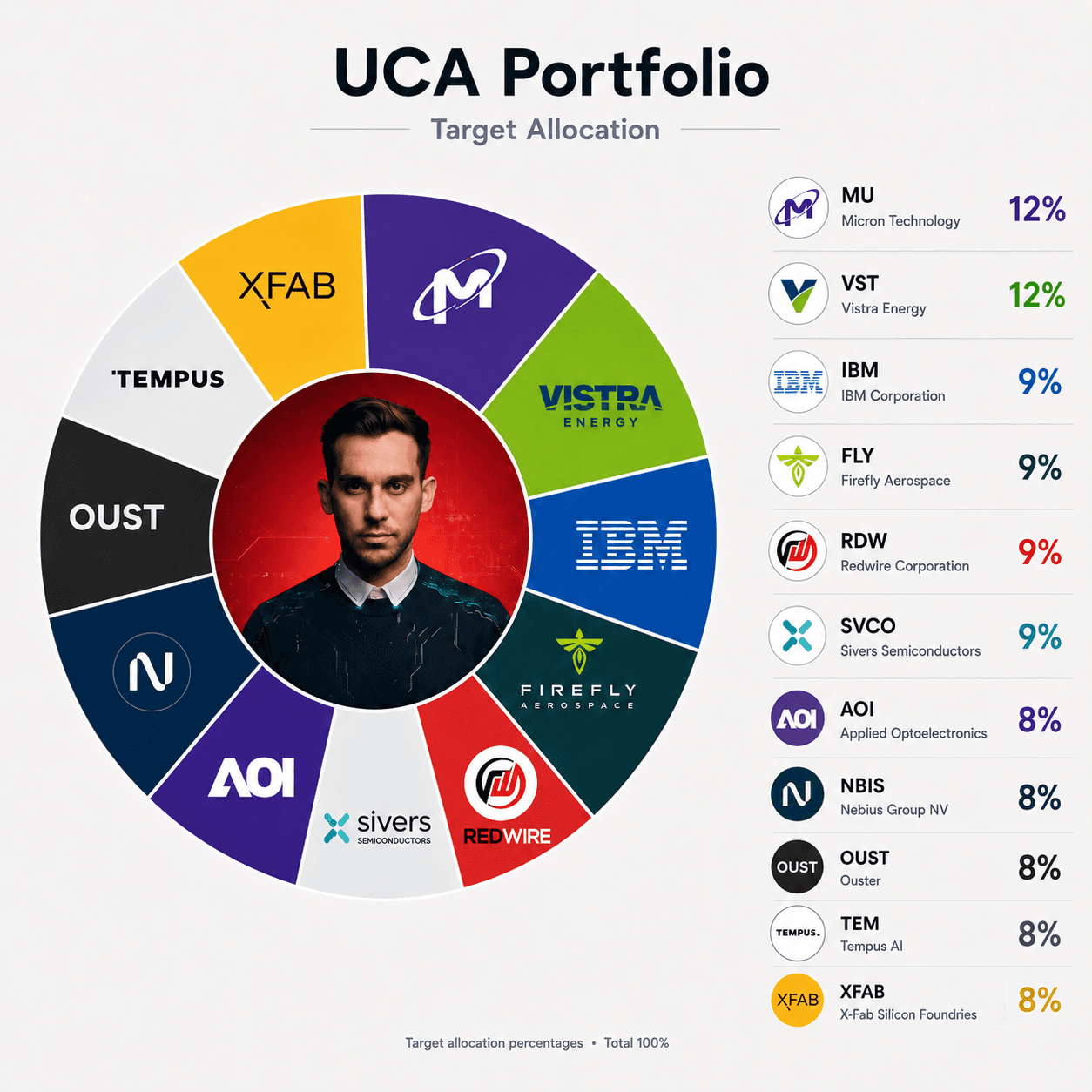
I invest in companies that sit at critical inflection points — businesses where a shifting technological landscape creates an urgent, structural need that the market has not yet fully priced in. My focus is on identifying bottlenecks within complex supply chains: the quiet, often overlooked producers of components, services, or infrastructure that everything else depends on. Before any financial analysis, I study the company's story — its origin, the sector it operates in, and crucially, its demonstrated ability to adapt as the rules of its industry change around it. I then examine management with equal rigor: are they aggressively and intelligently working to improve operational effectiveness, or simply riding a favorable cycle? The financials tell the next chapter — I want to see gross profit expanding, liquidity strengthening, and a business model that can meet growing demand without breaking under pressure. A healthy backlog or pipeline is not just a revenue signal; it is evidence that customers are committing to this company's future ahead of time. Finally, I look for genuine competitive separation — not incremental advantages, but cases where the company leads decisively in one or more dimensions that matter: proprietary data, sole-source positioning, regulatory depth, or ecosystem lock-in. When the story, the sector dynamics, the management quality, the financial trajectory, and a real competitive edge all converge — that is where I invest.
I invest in companies that sit at critical inflection points — businesses where a shifting technological landscape creates an urgent, structural need that the market has not yet fully priced in. My focus is on identifying bottlenecks within complex supply chains: the quiet, often overlooked producers of components, services, or infrastructure that everything else depends on. Before any financial analysis, I study the company's story — its origin, the sector it operates in, and crucially, its demonstrated ability to adapt as the rules of its industry change around it. I then examine management with equal rigor: are they aggressively and intelligently working to improve operational effectiveness, or simply riding a favorable cycle? The financials tell the next chapter — I want to see gross profit expanding, liquidity strengthening, and a business model that can meet growing demand without breaking under pressure. A healthy backlog or pipeline is not just a revenue signal; it is evidence that customers are committing to this company's future ahead of time. Finally, I look for genuine competitive separation — not incremental advantages, but cases where the company leads decisively in one or more dimensions that matter: proprietary data, sole-source positioning, regulatory depth, or ecosystem lock-in. When the story, the sector dynamics, the management quality, the financial trajectory, and a real competitive edge all converge — that is where I invest.
I invest in companies that sit at critical inflection points — businesses where a shifting technological landscape creates an urgent, structural need that the market has not yet fully priced in. My focus is on identifying bottlenecks within complex supply chains: the quiet, often overlooked producers of components, services, or infrastructure that everything else depends on. Before any financial analysis, I study the company's story — its origin, the sector it operates in, and crucially, its demonstrated ability to adapt as the rules of its industry change around it. I then examine management with equal rigor: are they aggressively and intelligently working to improve operational effectiveness, or simply riding a favorable cycle? The financials tell the next chapter — I want to see gross profit expanding, liquidity strengthening, and a business model that can meet growing demand without breaking under pressure. A healthy backlog or pipeline is not just a revenue signal; it is evidence that customers are committing to this company's future ahead of time. Finally, I look for genuine competitive separation — not incremental advantages, but cases where the company leads decisively in one or more dimensions that matter: proprietary data, sole-source positioning, regulatory depth, or ecosystem lock-in. When the story, the sector dynamics, the management quality, the financial trajectory, and a real competitive edge all converge — that is where I invest.
UCA Portfolio — Investment Thesis
Eleven Holdings | Bottleneck Positioning | Supply Chain Moats | Physical AI Infrastructure
Micron Technology (MU) — 12% Allocation Micron Technology is one of only three companies in the world capable of manufacturing leading-edge DRAM and NAND memory at scale — a list that has not meaningfully expanded in decades and is unlikely to do so given the capital intensity and process complexity required. The company sits at an absolute bottleneck in the global semiconductor supply chain: without high-bandwidth memory, modern AI accelerators simply cannot function at the throughput the industry demands. As AI model inference scales from data centers to edge devices, the appetite for HBM and low-power LPDDR expands structurally, not cyclically. Micron's manufacturing know-how is accumulated over more than forty years, representing institutional knowledge that cannot be replicated by writing a check. Management has demonstrated disciplined capital allocation through industry downturns, using trough periods to invest in next-generation process nodes rather than retreating, which positions the company to capture disproportionate margin on the upswing. The gross margin profile of memory expands sharply when product mix shifts toward high-value, AI-specific variants, and Micron is deliberately engineering that transition. Its customer relationships span every major hyperscaler and AI chip designer, creating a diversified pipeline that insulates revenue from single-customer concentration. For a portfolio built on physical scarcity in the AI supply chain, Micron is the most foundational single position — the picks-and-shovels of picks-and-shovels.
Vistra Energy (VST) — 12% Allocation Energy is the defining bottleneck of the AI era, and Vistra is the largest competitive power generator in the United States — a position that took decades of infrastructure investment to build and cannot be replicated quickly. The company operates an extraordinarily diverse generation fleet spanning natural gas, nuclear, solar, and battery storage, giving it the operational flexibility to meet baseload demand at scale regardless of weather or fuel-price volatility. Its nuclear fleet is particularly strategic: operating existing nuclear capacity is far cheaper and faster than building new generation, and the regulatory moat around those operating licenses is virtually impenetrable. As hyperscalers scramble to secure long-term power for AI data centers, Vistra is one of a very small number of counterparties with the generation capacity to sign meaningful, decade-long power purchase agreements. Management has shown sophisticated capital allocation by retiring debt, returning capital to shareholders, and selectively investing in battery storage to capture peak-pricing opportunities — a sign of operational discipline rather than growth-at-any-cost thinking. The gross margin profile of power generation improves materially when baseload contracts are signed at favorable long-term rates, locking in economics that are insulated from spot-market volatility. The structural demand from AI infrastructure is not a one-year trend but a multi-decade build-out, and Vistra owns some of the most critical physical assets in that story.
IBM Corporation (IBM) — 9% Allocation IBM has spent more than a century embedded in the operational infrastructure of the world's largest enterprises and governments — a depth of institutional relationship that no cloud-native competitor can replicate through a sales cycle. The company's mainframe ecosystem, despite being routinely dismissed as legacy, continues to process the majority of the world's financial transactions, and the cost and risk of migrating away from it is so prohibitive that it functionally guarantees recurring revenue for decades. IBM's pivot toward hybrid cloud and enterprise AI is not a desperate reinvention but a natural extension of its core identity: helping large organizations run complex systems reliably at scale. Its Red Hat acquisition gave it a genuinely open, interoperable platform that sits at the center of enterprise Kubernetes deployments — a sticky, recurring-revenue business with strong gross margins. Management under Arvind Krishna has demonstrated unusual clarity in articulating a focused strategy, spinning off the managed infrastructure business and concentrating investment on software and consulting margins. The consulting division is not generic IT services but deep integration work that creates switching costs proportional to the complexity of the systems involved. IBM's backlog of multi-year enterprise contracts provides revenue visibility that few technology companies can match, making the financial profile more predictable than the volatile SaaS growth market. For a portfolio thesis centered on structural necessity and bottleneck positioning, IBM is the enterprise AI plumbing play — unglamorous, deeply embedded, and extraordinarily difficult to displace.
Firefly Aerospace (FLY) — 9% Allocation Firefly Aerospace is positioned at the intersection of two of the most important structural shifts of this decade: the commercialization of low-Earth orbit and the growing dependency of defense and intelligence agencies on responsive, dedicated launch. The company's Alpha rocket fills a gap in the market that no one else currently fills with the same cost profile and cadence — small-to-medium payloads on dedicated missions without forcing customers to rideshare on someone else's timeline. This mission-dedicated flexibility is not a feature; it is a fundamental operational requirement for defense and intelligence customers who cannot afford to have their satellites sitting in a queue. Firefly's contract with NASA and its growing relationship with the U.S. Space Force signal a level of programmatic trust that takes years to earn and is not easily revoked once established. The company has demonstrated the ability to move from failure and iteration to successful orbital delivery — the most valuable proof point in the aerospace industry because it confirms that the engineering and manufacturing team can solve hard problems under pressure. Its Blue Ghost lunar lander program, which successfully delivered payloads to the Moon, establishes Firefly in the cislunar economy ahead of most competitors. Management has shown the focused intensity of a company that understands it must build operational credibility faster than its funding runway shrinks. The pipeline of launch contracts and government task orders provides backlog visibility that justifies confidence in near-term revenue even before the full market for small-sat constellations develops.
Redwire Corporation (RDW) — 9% Allocation Redwire is one of the few companies in the world that designs and manufactures the actual hardware that lives in space — solar arrays, deployable structures, and in-space manufacturing systems — rather than just launching or operating satellites. This distinction matters enormously: space hardware is one of the most technically demanding manufacturing disciplines on earth, and Redwire's heritage traces through legacy aerospace primes with collective experience spanning decades of missions. Its deployable solar array technology powers some of the most critical government and commercial spacecraft in operation today, creating a sole-source dynamic where the customer's satellite literally cannot function without Redwire's component. The company's expansion into in-space manufacturing — producing materials and structures in microgravity that cannot be made on earth — positions it at the frontier of a market that does not yet exist at scale, creating first-mover advantages that compound with every successful demonstration mission. Management has been aggressive in building capabilities through acquisition, assembling a portfolio of space hardware competencies under one roof that would take a competitor a decade to replicate organically. The contract backlog reflects multi-year government programs where switching costs are effectively prohibitive once a component has been integrated into a spacecraft design. Redwire's relationship with NASA's Commercial LEO Destinations program positions it for recurring revenue in the post-ISS era, not just one-time hardware deliveries. In a portfolio built on physical scarcity and supply chain bottlenecks, Redwire is the most literal expression of that thesis — it builds the hardware that makes space infrastructure physically possible.
Sivers Semiconductors (SVCO) — 9% Allocation Sivers Semiconductors sits at one of the most constrained chokepoints in the entire AI infrastructure supply chain: the production of indium phosphide photonic chips, which are the physical medium through which data travels between AI accelerators at speeds that silicon electronics cannot support. As AI clusters scale from thousands to hundreds of thousands of GPUs, the electrical interconnects that once sufficed become a bottleneck, and optical interconnects based on compound semiconductors like InP become not just preferable but physically necessary. Sivers is one of a very small number of companies globally with the wafer fabrication capability, process know-how, and IP portfolio to manufacture InP components at the quality and consistency that data center customers require. The company's technology also serves millimeter-wave and 5G applications, giving it multiple demand vectors rather than single-market exposure. Its manufacturing process is the product of years of materials science iteration that cannot be shortcut — the learning curve embedded in compound semiconductor fabrication is a moat as real as any patent portfolio. Management has been methodical in converting technology capability into commercial relationships with Tier 1 customers who need supply chain certainty, not just the best prototype. The pipeline of design wins across both photonics and wireless represents future revenue that does not appear on the income statement today but reflects commitments made by customers who have already done the qualification work. For a portfolio thesis centered on physical supply chain bottlenecks in AI infrastructure, Sivers is among the most structurally positioned companies in the world.
Applied Optoelectronics (AOI) — 8% Allocation Applied Optoelectronics manufactures the laser-based optical transceivers and components that physically move data through fiber-optic networks at hyperscale speeds — a product category that is structurally indispensable to every AI data center being built today. The company has spent decades developing vertical integration across the optical supply chain, from laser chip fabrication through module assembly, giving it cost and quality control advantages that pure-play assemblers cannot match. As data center operators push interconnect speeds from 400G toward 800G and 1.6T, the optical components required become more technically demanding and the number of qualified suppliers shrinks — creating precisely the supply constraint dynamic that drives pricing power. AOI's direct customer relationships with the largest cloud operators provide both revenue concentration risk and, viewed differently, the highest-value validation possible: these customers are extraordinarily demanding and do not qualify suppliers they do not need. Management has navigated a highly cyclical industry by investing through downturns in next-generation product development rather than cutting R&D when orders soften, which has consistently allowed the company to capture outsized share when demand recovers. The backlog and order pipeline from AI infrastructure buildouts represents a demand environment categorically different from the cable TV transceiver market that once defined AOI's revenue mix. The gross margin profile improves materially as product mix shifts toward higher-speed, AI-specific data center components, which is the strategic transition the company has been engineering for years.
Nebius Group NV (NBIS) — 8% Allocation Nebius is a purpose-built AI cloud infrastructure company founded by the engineering and operational leadership that built Yandex into one of the most technically sophisticated internet companies in the world — a pedigree that matters enormously in a capital-intensive industry where execution discipline separates winners from expensive failures. The company is constructing AI-optimized data centers and cloud compute infrastructure designed from the ground up for GPU-dense AI workloads, rather than retrofitting general-purpose cloud architecture that was never designed for this use case. This architectural differentiation means better utilization rates, better thermal management, and better economics for AI training and inference customers relative to general-purpose cloud providers. Nebius operates at a rare intersection: the technical depth of a hyperscaler with the organizational agility of a growth company, a combination that is genuinely difficult to find in infrastructure. Its expansion into European markets gives it geographic diversification at a time when AI sovereignty and data residency requirements are making European AI infrastructure capacity a political as well as commercial priority. Management's track record of building and operating complex infrastructure at scale de-risks the execution question that typically haunts companies at this stage. The pipeline of enterprise and research customers seeking dedicated, high-performance AI compute is structurally undersupplied, creating a demand environment where capacity can be pre-committed before it is built. In a portfolio thesis built on physical AI infrastructure scarcity, Nebius is the compute layer — the direct enabler of AI workloads for customers who need more than the hyperscalers can offer.
Ouster (OUST) — 8% Allocation Ouster builds digital lidar sensors — the perception hardware that allows machines to understand physical space in three dimensions — and has differentiated itself from the first generation of lidar companies by building its sensors on standard CMOS semiconductor manufacturing rather than bespoke processes, which drives dramatically lower cost curves as production scales. This manufacturing approach is not incremental; it is a structural advantage that allows Ouster to access the same cost-reduction dynamics that the broader semiconductor industry has enjoyed for decades. The company's merger with Velodyne combined the two most prominent lidar brands, creating a combined IP portfolio, customer base, and manufacturing scale that is more defensible than either entity alone. Lidar is a critical sensing input for autonomous vehicles, industrial robotics, smart infrastructure, and a growing range of defense applications — markets that are each independently large and collectively represent one of the most consequential physical AI buildouts of the next two decades. Management has focused relentlessly on driving down the cost per unit and expanding the addressable market by making lidar economically viable for applications where it was previously too expensive. The customer pipeline spans automotive OEMs, industrial automation integrators, and government programs — a diversified demand base that reduces dependency on any single market's adoption timeline. As physical AI — robots, autonomous systems, smart factories — becomes the next wave of AI application, the sensors that give those systems spatial awareness become as critical as the chips that give them computational power.
Tempus AI (TEM) — 8% Allocation Tempus AI has spent years doing something extraordinarily difficult and underappreciated: collecting, structuring, and linking clinical, genomic, and imaging data from real patient care at scale — a dataset that cannot be assembled from a standing start regardless of budget or technical talent. The company operates at the intersection of healthcare delivery and AI, providing oncologists and researchers with intelligence derived from one of the largest and most richly annotated multimodal health datasets in existence. This data moat is the defining characteristic of the investment thesis: every patient record processed, every genomic sequence linked to a clinical outcome, every imaging study annotated deepens a resource that competitors must spend years — not quarters — to approximate. Tempus's business model is structured such that the act of delivering clinical services simultaneously generates the data that makes those services more valuable over time, a compounding dynamic that strengthens the moat with each interaction. Management has demonstrated the vision to build a data infrastructure business inside what looks from the outside like a diagnostics company — a framing gap that creates the opportunity. The regulatory environment around clinical AI is becoming clearer rather than more restrictive, and Tempus's existing relationships with health systems and pharmaceutical companies for clinical trial matching represent a pipeline of recurring, high-value engagements. The pharmaceutical R&D market alone — using real-world data to design trials, identify patient populations, and measure outcomes — represents a commercial opportunity large enough to justify the entire company. In a portfolio that prizes structurally irreplicable data assets, Tempus is the most compelling expression of that principle in healthcare.
X-Fab Silicon Foundries (XFAB) — 8% Allocation X-Fab is a specialty analog and mixed-signal semiconductor foundry — a category of manufacturing that serves markets where the physics of the real world matters more than digital logic density, and where the engineering process knowledge accumulated over decades is the barrier to entry that no amount of capital can shortcut. Unlike leading-edge logic foundries chasing nanometer shrinks, X-Fab's value is in mastering complex specialty processes for automotive, medical, industrial, and increasingly photonic applications — markets with extraordinarily demanding reliability and qualification requirements that take years to satisfy. Its SiGe and silicon photonics process capabilities are directly relevant to the optical interconnect buildout that AI infrastructure demands, positioning X-Fab as a quiet but critical supplier to companies racing to solve the data center bandwidth problem. The automotive qualification moat is particularly durable: once a semiconductor process has been designed into a vehicle platform and certified to AEC-Q standards, it remains in that platform for the entire production run, which can span a decade or more. Management has built a geographically diversified fab network across Europe and the United States, which is increasingly strategically valuable as customers seek supply chain resilience and regional production guarantees. The company's customer relationships are deep and long-duration by nature — specialty processes require joint development work that creates technical lock-in at the design level, not just the purchasing level. X-Fab's backlog reflects the multi-year design win cycles of its end markets, providing revenue visibility that pure commodity foundries cannot offer. For a portfolio seeking supply chain chokepoints, X-Fab is the specialty fabrication layer — the manufacturer that makes sensors, power chips, and photonic components possible when standard silicon cannot do the job.
UCA Portfolio — Investment Thesis
Eleven Holdings | Bottleneck Positioning | Supply Chain Moats | Physical AI Infrastructure
Micron Technology (MU) — 12% Allocation Micron Technology is one of only three companies in the world capable of manufacturing leading-edge DRAM and NAND memory at scale — a list that has not meaningfully expanded in decades and is unlikely to do so given the capital intensity and process complexity required. The company sits at an absolute bottleneck in the global semiconductor supply chain: without high-bandwidth memory, modern AI accelerators simply cannot function at the throughput the industry demands. As AI model inference scales from data centers to edge devices, the appetite for HBM and low-power LPDDR expands structurally, not cyclically. Micron's manufacturing know-how is accumulated over more than forty years, representing institutional knowledge that cannot be replicated by writing a check. Management has demonstrated disciplined capital allocation through industry downturns, using trough periods to invest in next-generation process nodes rather than retreating, which positions the company to capture disproportionate margin on the upswing. The gross margin profile of memory expands sharply when product mix shifts toward high-value, AI-specific variants, and Micron is deliberately engineering that transition. Its customer relationships span every major hyperscaler and AI chip designer, creating a diversified pipeline that insulates revenue from single-customer concentration. For a portfolio built on physical scarcity in the AI supply chain, Micron is the most foundational single position — the picks-and-shovels of picks-and-shovels.
Vistra Energy (VST) — 12% Allocation Energy is the defining bottleneck of the AI era, and Vistra is the largest competitive power generator in the United States — a position that took decades of infrastructure investment to build and cannot be replicated quickly. The company operates an extraordinarily diverse generation fleet spanning natural gas, nuclear, solar, and battery storage, giving it the operational flexibility to meet baseload demand at scale regardless of weather or fuel-price volatility. Its nuclear fleet is particularly strategic: operating existing nuclear capacity is far cheaper and faster than building new generation, and the regulatory moat around those operating licenses is virtually impenetrable. As hyperscalers scramble to secure long-term power for AI data centers, Vistra is one of a very small number of counterparties with the generation capacity to sign meaningful, decade-long power purchase agreements. Management has shown sophisticated capital allocation by retiring debt, returning capital to shareholders, and selectively investing in battery storage to capture peak-pricing opportunities — a sign of operational discipline rather than growth-at-any-cost thinking. The gross margin profile of power generation improves materially when baseload contracts are signed at favorable long-term rates, locking in economics that are insulated from spot-market volatility. The structural demand from AI infrastructure is not a one-year trend but a multi-decade build-out, and Vistra owns some of the most critical physical assets in that story.
IBM Corporation (IBM) — 9% Allocation IBM has spent more than a century embedded in the operational infrastructure of the world's largest enterprises and governments — a depth of institutional relationship that no cloud-native competitor can replicate through a sales cycle. The company's mainframe ecosystem, despite being routinely dismissed as legacy, continues to process the majority of the world's financial transactions, and the cost and risk of migrating away from it is so prohibitive that it functionally guarantees recurring revenue for decades. IBM's pivot toward hybrid cloud and enterprise AI is not a desperate reinvention but a natural extension of its core identity: helping large organizations run complex systems reliably at scale. Its Red Hat acquisition gave it a genuinely open, interoperable platform that sits at the center of enterprise Kubernetes deployments — a sticky, recurring-revenue business with strong gross margins. Management under Arvind Krishna has demonstrated unusual clarity in articulating a focused strategy, spinning off the managed infrastructure business and concentrating investment on software and consulting margins. The consulting division is not generic IT services but deep integration work that creates switching costs proportional to the complexity of the systems involved. IBM's backlog of multi-year enterprise contracts provides revenue visibility that few technology companies can match, making the financial profile more predictable than the volatile SaaS growth market. For a portfolio thesis centered on structural necessity and bottleneck positioning, IBM is the enterprise AI plumbing play — unglamorous, deeply embedded, and extraordinarily difficult to displace.
Firefly Aerospace (FLY) — 9% Allocation Firefly Aerospace is positioned at the intersection of two of the most important structural shifts of this decade: the commercialization of low-Earth orbit and the growing dependency of defense and intelligence agencies on responsive, dedicated launch. The company's Alpha rocket fills a gap in the market that no one else currently fills with the same cost profile and cadence — small-to-medium payloads on dedicated missions without forcing customers to rideshare on someone else's timeline. This mission-dedicated flexibility is not a feature; it is a fundamental operational requirement for defense and intelligence customers who cannot afford to have their satellites sitting in a queue. Firefly's contract with NASA and its growing relationship with the U.S. Space Force signal a level of programmatic trust that takes years to earn and is not easily revoked once established. The company has demonstrated the ability to move from failure and iteration to successful orbital delivery — the most valuable proof point in the aerospace industry because it confirms that the engineering and manufacturing team can solve hard problems under pressure. Its Blue Ghost lunar lander program, which successfully delivered payloads to the Moon, establishes Firefly in the cislunar economy ahead of most competitors. Management has shown the focused intensity of a company that understands it must build operational credibility faster than its funding runway shrinks. The pipeline of launch contracts and government task orders provides backlog visibility that justifies confidence in near-term revenue even before the full market for small-sat constellations develops.
Redwire Corporation (RDW) — 9% Allocation Redwire is one of the few companies in the world that designs and manufactures the actual hardware that lives in space — solar arrays, deployable structures, and in-space manufacturing systems — rather than just launching or operating satellites. This distinction matters enormously: space hardware is one of the most technically demanding manufacturing disciplines on earth, and Redwire's heritage traces through legacy aerospace primes with collective experience spanning decades of missions. Its deployable solar array technology powers some of the most critical government and commercial spacecraft in operation today, creating a sole-source dynamic where the customer's satellite literally cannot function without Redwire's component. The company's expansion into in-space manufacturing — producing materials and structures in microgravity that cannot be made on earth — positions it at the frontier of a market that does not yet exist at scale, creating first-mover advantages that compound with every successful demonstration mission. Management has been aggressive in building capabilities through acquisition, assembling a portfolio of space hardware competencies under one roof that would take a competitor a decade to replicate organically. The contract backlog reflects multi-year government programs where switching costs are effectively prohibitive once a component has been integrated into a spacecraft design. Redwire's relationship with NASA's Commercial LEO Destinations program positions it for recurring revenue in the post-ISS era, not just one-time hardware deliveries. In a portfolio built on physical scarcity and supply chain bottlenecks, Redwire is the most literal expression of that thesis — it builds the hardware that makes space infrastructure physically possible.
Sivers Semiconductors (SVCO) — 9% Allocation Sivers Semiconductors sits at one of the most constrained chokepoints in the entire AI infrastructure supply chain: the production of indium phosphide photonic chips, which are the physical medium through which data travels between AI accelerators at speeds that silicon electronics cannot support. As AI clusters scale from thousands to hundreds of thousands of GPUs, the electrical interconnects that once sufficed become a bottleneck, and optical interconnects based on compound semiconductors like InP become not just preferable but physically necessary. Sivers is one of a very small number of companies globally with the wafer fabrication capability, process know-how, and IP portfolio to manufacture InP components at the quality and consistency that data center customers require. The company's technology also serves millimeter-wave and 5G applications, giving it multiple demand vectors rather than single-market exposure. Its manufacturing process is the product of years of materials science iteration that cannot be shortcut — the learning curve embedded in compound semiconductor fabrication is a moat as real as any patent portfolio. Management has been methodical in converting technology capability into commercial relationships with Tier 1 customers who need supply chain certainty, not just the best prototype. The pipeline of design wins across both photonics and wireless represents future revenue that does not appear on the income statement today but reflects commitments made by customers who have already done the qualification work. For a portfolio thesis centered on physical supply chain bottlenecks in AI infrastructure, Sivers is among the most structurally positioned companies in the world.
Applied Optoelectronics (AOI) — 8% Allocation Applied Optoelectronics manufactures the laser-based optical transceivers and components that physically move data through fiber-optic networks at hyperscale speeds — a product category that is structurally indispensable to every AI data center being built today. The company has spent decades developing vertical integration across the optical supply chain, from laser chip fabrication through module assembly, giving it cost and quality control advantages that pure-play assemblers cannot match. As data center operators push interconnect speeds from 400G toward 800G and 1.6T, the optical components required become more technically demanding and the number of qualified suppliers shrinks — creating precisely the supply constraint dynamic that drives pricing power. AOI's direct customer relationships with the largest cloud operators provide both revenue concentration risk and, viewed differently, the highest-value validation possible: these customers are extraordinarily demanding and do not qualify suppliers they do not need. Management has navigated a highly cyclical industry by investing through downturns in next-generation product development rather than cutting R&D when orders soften, which has consistently allowed the company to capture outsized share when demand recovers. The backlog and order pipeline from AI infrastructure buildouts represents a demand environment categorically different from the cable TV transceiver market that once defined AOI's revenue mix. The gross margin profile improves materially as product mix shifts toward higher-speed, AI-specific data center components, which is the strategic transition the company has been engineering for years.
Nebius Group NV (NBIS) — 8% Allocation Nebius is a purpose-built AI cloud infrastructure company founded by the engineering and operational leadership that built Yandex into one of the most technically sophisticated internet companies in the world — a pedigree that matters enormously in a capital-intensive industry where execution discipline separates winners from expensive failures. The company is constructing AI-optimized data centers and cloud compute infrastructure designed from the ground up for GPU-dense AI workloads, rather than retrofitting general-purpose cloud architecture that was never designed for this use case. This architectural differentiation means better utilization rates, better thermal management, and better economics for AI training and inference customers relative to general-purpose cloud providers. Nebius operates at a rare intersection: the technical depth of a hyperscaler with the organizational agility of a growth company, a combination that is genuinely difficult to find in infrastructure. Its expansion into European markets gives it geographic diversification at a time when AI sovereignty and data residency requirements are making European AI infrastructure capacity a political as well as commercial priority. Management's track record of building and operating complex infrastructure at scale de-risks the execution question that typically haunts companies at this stage. The pipeline of enterprise and research customers seeking dedicated, high-performance AI compute is structurally undersupplied, creating a demand environment where capacity can be pre-committed before it is built. In a portfolio thesis built on physical AI infrastructure scarcity, Nebius is the compute layer — the direct enabler of AI workloads for customers who need more than the hyperscalers can offer.
Ouster (OUST) — 8% Allocation Ouster builds digital lidar sensors — the perception hardware that allows machines to understand physical space in three dimensions — and has differentiated itself from the first generation of lidar companies by building its sensors on standard CMOS semiconductor manufacturing rather than bespoke processes, which drives dramatically lower cost curves as production scales. This manufacturing approach is not incremental; it is a structural advantage that allows Ouster to access the same cost-reduction dynamics that the broader semiconductor industry has enjoyed for decades. The company's merger with Velodyne combined the two most prominent lidar brands, creating a combined IP portfolio, customer base, and manufacturing scale that is more defensible than either entity alone. Lidar is a critical sensing input for autonomous vehicles, industrial robotics, smart infrastructure, and a growing range of defense applications — markets that are each independently large and collectively represent one of the most consequential physical AI buildouts of the next two decades. Management has focused relentlessly on driving down the cost per unit and expanding the addressable market by making lidar economically viable for applications where it was previously too expensive. The customer pipeline spans automotive OEMs, industrial automation integrators, and government programs — a diversified demand base that reduces dependency on any single market's adoption timeline. As physical AI — robots, autonomous systems, smart factories — becomes the next wave of AI application, the sensors that give those systems spatial awareness become as critical as the chips that give them computational power.
Tempus AI (TEM) — 8% Allocation Tempus AI has spent years doing something extraordinarily difficult and underappreciated: collecting, structuring, and linking clinical, genomic, and imaging data from real patient care at scale — a dataset that cannot be assembled from a standing start regardless of budget or technical talent. The company operates at the intersection of healthcare delivery and AI, providing oncologists and researchers with intelligence derived from one of the largest and most richly annotated multimodal health datasets in existence. This data moat is the defining characteristic of the investment thesis: every patient record processed, every genomic sequence linked to a clinical outcome, every imaging study annotated deepens a resource that competitors must spend years — not quarters — to approximate. Tempus's business model is structured such that the act of delivering clinical services simultaneously generates the data that makes those services more valuable over time, a compounding dynamic that strengthens the moat with each interaction. Management has demonstrated the vision to build a data infrastructure business inside what looks from the outside like a diagnostics company — a framing gap that creates the opportunity. The regulatory environment around clinical AI is becoming clearer rather than more restrictive, and Tempus's existing relationships with health systems and pharmaceutical companies for clinical trial matching represent a pipeline of recurring, high-value engagements. The pharmaceutical R&D market alone — using real-world data to design trials, identify patient populations, and measure outcomes — represents a commercial opportunity large enough to justify the entire company. In a portfolio that prizes structurally irreplicable data assets, Tempus is the most compelling expression of that principle in healthcare.
X-Fab Silicon Foundries (XFAB) — 8% Allocation X-Fab is a specialty analog and mixed-signal semiconductor foundry — a category of manufacturing that serves markets where the physics of the real world matters more than digital logic density, and where the engineering process knowledge accumulated over decades is the barrier to entry that no amount of capital can shortcut. Unlike leading-edge logic foundries chasing nanometer shrinks, X-Fab's value is in mastering complex specialty processes for automotive, medical, industrial, and increasingly photonic applications — markets with extraordinarily demanding reliability and qualification requirements that take years to satisfy. Its SiGe and silicon photonics process capabilities are directly relevant to the optical interconnect buildout that AI infrastructure demands, positioning X-Fab as a quiet but critical supplier to companies racing to solve the data center bandwidth problem. The automotive qualification moat is particularly durable: once a semiconductor process has been designed into a vehicle platform and certified to AEC-Q standards, it remains in that platform for the entire production run, which can span a decade or more. Management has built a geographically diversified fab network across Europe and the United States, which is increasingly strategically valuable as customers seek supply chain resilience and regional production guarantees. The company's customer relationships are deep and long-duration by nature — specialty processes require joint development work that creates technical lock-in at the design level, not just the purchasing level. X-Fab's backlog reflects the multi-year design win cycles of its end markets, providing revenue visibility that pure commodity foundries cannot offer. For a portfolio seeking supply chain chokepoints, X-Fab is the specialty fabrication layer — the manufacturer that makes sensors, power chips, and photonic components possible when standard silicon cannot do the job.
UCA Portfolio — Investment Thesis
Eleven Holdings | Bottleneck Positioning | Supply Chain Moats | Physical AI Infrastructure
Micron Technology (MU) — 12% Allocation Micron Technology is one of only three companies in the world capable of manufacturing leading-edge DRAM and NAND memory at scale — a list that has not meaningfully expanded in decades and is unlikely to do so given the capital intensity and process complexity required. The company sits at an absolute bottleneck in the global semiconductor supply chain: without high-bandwidth memory, modern AI accelerators simply cannot function at the throughput the industry demands. As AI model inference scales from data centers to edge devices, the appetite for HBM and low-power LPDDR expands structurally, not cyclically. Micron's manufacturing know-how is accumulated over more than forty years, representing institutional knowledge that cannot be replicated by writing a check. Management has demonstrated disciplined capital allocation through industry downturns, using trough periods to invest in next-generation process nodes rather than retreating, which positions the company to capture disproportionate margin on the upswing. The gross margin profile of memory expands sharply when product mix shifts toward high-value, AI-specific variants, and Micron is deliberately engineering that transition. Its customer relationships span every major hyperscaler and AI chip designer, creating a diversified pipeline that insulates revenue from single-customer concentration. For a portfolio built on physical scarcity in the AI supply chain, Micron is the most foundational single position — the picks-and-shovels of picks-and-shovels.
Vistra Energy (VST) — 12% Allocation Energy is the defining bottleneck of the AI era, and Vistra is the largest competitive power generator in the United States — a position that took decades of infrastructure investment to build and cannot be replicated quickly. The company operates an extraordinarily diverse generation fleet spanning natural gas, nuclear, solar, and battery storage, giving it the operational flexibility to meet baseload demand at scale regardless of weather or fuel-price volatility. Its nuclear fleet is particularly strategic: operating existing nuclear capacity is far cheaper and faster than building new generation, and the regulatory moat around those operating licenses is virtually impenetrable. As hyperscalers scramble to secure long-term power for AI data centers, Vistra is one of a very small number of counterparties with the generation capacity to sign meaningful, decade-long power purchase agreements. Management has shown sophisticated capital allocation by retiring debt, returning capital to shareholders, and selectively investing in battery storage to capture peak-pricing opportunities — a sign of operational discipline rather than growth-at-any-cost thinking. The gross margin profile of power generation improves materially when baseload contracts are signed at favorable long-term rates, locking in economics that are insulated from spot-market volatility. The structural demand from AI infrastructure is not a one-year trend but a multi-decade build-out, and Vistra owns some of the most critical physical assets in that story.
IBM Corporation (IBM) — 9% Allocation IBM has spent more than a century embedded in the operational infrastructure of the world's largest enterprises and governments — a depth of institutional relationship that no cloud-native competitor can replicate through a sales cycle. The company's mainframe ecosystem, despite being routinely dismissed as legacy, continues to process the majority of the world's financial transactions, and the cost and risk of migrating away from it is so prohibitive that it functionally guarantees recurring revenue for decades. IBM's pivot toward hybrid cloud and enterprise AI is not a desperate reinvention but a natural extension of its core identity: helping large organizations run complex systems reliably at scale. Its Red Hat acquisition gave it a genuinely open, interoperable platform that sits at the center of enterprise Kubernetes deployments — a sticky, recurring-revenue business with strong gross margins. Management under Arvind Krishna has demonstrated unusual clarity in articulating a focused strategy, spinning off the managed infrastructure business and concentrating investment on software and consulting margins. The consulting division is not generic IT services but deep integration work that creates switching costs proportional to the complexity of the systems involved. IBM's backlog of multi-year enterprise contracts provides revenue visibility that few technology companies can match, making the financial profile more predictable than the volatile SaaS growth market. For a portfolio thesis centered on structural necessity and bottleneck positioning, IBM is the enterprise AI plumbing play — unglamorous, deeply embedded, and extraordinarily difficult to displace.
Firefly Aerospace (FLY) — 9% Allocation Firefly Aerospace is positioned at the intersection of two of the most important structural shifts of this decade: the commercialization of low-Earth orbit and the growing dependency of defense and intelligence agencies on responsive, dedicated launch. The company's Alpha rocket fills a gap in the market that no one else currently fills with the same cost profile and cadence — small-to-medium payloads on dedicated missions without forcing customers to rideshare on someone else's timeline. This mission-dedicated flexibility is not a feature; it is a fundamental operational requirement for defense and intelligence customers who cannot afford to have their satellites sitting in a queue. Firefly's contract with NASA and its growing relationship with the U.S. Space Force signal a level of programmatic trust that takes years to earn and is not easily revoked once established. The company has demonstrated the ability to move from failure and iteration to successful orbital delivery — the most valuable proof point in the aerospace industry because it confirms that the engineering and manufacturing team can solve hard problems under pressure. Its Blue Ghost lunar lander program, which successfully delivered payloads to the Moon, establishes Firefly in the cislunar economy ahead of most competitors. Management has shown the focused intensity of a company that understands it must build operational credibility faster than its funding runway shrinks. The pipeline of launch contracts and government task orders provides backlog visibility that justifies confidence in near-term revenue even before the full market for small-sat constellations develops.
Redwire Corporation (RDW) — 9% Allocation Redwire is one of the few companies in the world that designs and manufactures the actual hardware that lives in space — solar arrays, deployable structures, and in-space manufacturing systems — rather than just launching or operating satellites. This distinction matters enormously: space hardware is one of the most technically demanding manufacturing disciplines on earth, and Redwire's heritage traces through legacy aerospace primes with collective experience spanning decades of missions. Its deployable solar array technology powers some of the most critical government and commercial spacecraft in operation today, creating a sole-source dynamic where the customer's satellite literally cannot function without Redwire's component. The company's expansion into in-space manufacturing — producing materials and structures in microgravity that cannot be made on earth — positions it at the frontier of a market that does not yet exist at scale, creating first-mover advantages that compound with every successful demonstration mission. Management has been aggressive in building capabilities through acquisition, assembling a portfolio of space hardware competencies under one roof that would take a competitor a decade to replicate organically. The contract backlog reflects multi-year government programs where switching costs are effectively prohibitive once a component has been integrated into a spacecraft design. Redwire's relationship with NASA's Commercial LEO Destinations program positions it for recurring revenue in the post-ISS era, not just one-time hardware deliveries. In a portfolio built on physical scarcity and supply chain bottlenecks, Redwire is the most literal expression of that thesis — it builds the hardware that makes space infrastructure physically possible.
Sivers Semiconductors (SVCO) — 9% Allocation Sivers Semiconductors sits at one of the most constrained chokepoints in the entire AI infrastructure supply chain: the production of indium phosphide photonic chips, which are the physical medium through which data travels between AI accelerators at speeds that silicon electronics cannot support. As AI clusters scale from thousands to hundreds of thousands of GPUs, the electrical interconnects that once sufficed become a bottleneck, and optical interconnects based on compound semiconductors like InP become not just preferable but physically necessary. Sivers is one of a very small number of companies globally with the wafer fabrication capability, process know-how, and IP portfolio to manufacture InP components at the quality and consistency that data center customers require. The company's technology also serves millimeter-wave and 5G applications, giving it multiple demand vectors rather than single-market exposure. Its manufacturing process is the product of years of materials science iteration that cannot be shortcut — the learning curve embedded in compound semiconductor fabrication is a moat as real as any patent portfolio. Management has been methodical in converting technology capability into commercial relationships with Tier 1 customers who need supply chain certainty, not just the best prototype. The pipeline of design wins across both photonics and wireless represents future revenue that does not appear on the income statement today but reflects commitments made by customers who have already done the qualification work. For a portfolio thesis centered on physical supply chain bottlenecks in AI infrastructure, Sivers is among the most structurally positioned companies in the world.
Applied Optoelectronics (AOI) — 8% Allocation Applied Optoelectronics manufactures the laser-based optical transceivers and components that physically move data through fiber-optic networks at hyperscale speeds — a product category that is structurally indispensable to every AI data center being built today. The company has spent decades developing vertical integration across the optical supply chain, from laser chip fabrication through module assembly, giving it cost and quality control advantages that pure-play assemblers cannot match. As data center operators push interconnect speeds from 400G toward 800G and 1.6T, the optical components required become more technically demanding and the number of qualified suppliers shrinks — creating precisely the supply constraint dynamic that drives pricing power. AOI's direct customer relationships with the largest cloud operators provide both revenue concentration risk and, viewed differently, the highest-value validation possible: these customers are extraordinarily demanding and do not qualify suppliers they do not need. Management has navigated a highly cyclical industry by investing through downturns in next-generation product development rather than cutting R&D when orders soften, which has consistently allowed the company to capture outsized share when demand recovers. The backlog and order pipeline from AI infrastructure buildouts represents a demand environment categorically different from the cable TV transceiver market that once defined AOI's revenue mix. The gross margin profile improves materially as product mix shifts toward higher-speed, AI-specific data center components, which is the strategic transition the company has been engineering for years.
Nebius Group NV (NBIS) — 8% Allocation Nebius is a purpose-built AI cloud infrastructure company founded by the engineering and operational leadership that built Yandex into one of the most technically sophisticated internet companies in the world — a pedigree that matters enormously in a capital-intensive industry where execution discipline separates winners from expensive failures. The company is constructing AI-optimized data centers and cloud compute infrastructure designed from the ground up for GPU-dense AI workloads, rather than retrofitting general-purpose cloud architecture that was never designed for this use case. This architectural differentiation means better utilization rates, better thermal management, and better economics for AI training and inference customers relative to general-purpose cloud providers. Nebius operates at a rare intersection: the technical depth of a hyperscaler with the organizational agility of a growth company, a combination that is genuinely difficult to find in infrastructure. Its expansion into European markets gives it geographic diversification at a time when AI sovereignty and data residency requirements are making European AI infrastructure capacity a political as well as commercial priority. Management's track record of building and operating complex infrastructure at scale de-risks the execution question that typically haunts companies at this stage. The pipeline of enterprise and research customers seeking dedicated, high-performance AI compute is structurally undersupplied, creating a demand environment where capacity can be pre-committed before it is built. In a portfolio thesis built on physical AI infrastructure scarcity, Nebius is the compute layer — the direct enabler of AI workloads for customers who need more than the hyperscalers can offer.
Ouster (OUST) — 8% Allocation Ouster builds digital lidar sensors — the perception hardware that allows machines to understand physical space in three dimensions — and has differentiated itself from the first generation of lidar companies by building its sensors on standard CMOS semiconductor manufacturing rather than bespoke processes, which drives dramatically lower cost curves as production scales. This manufacturing approach is not incremental; it is a structural advantage that allows Ouster to access the same cost-reduction dynamics that the broader semiconductor industry has enjoyed for decades. The company's merger with Velodyne combined the two most prominent lidar brands, creating a combined IP portfolio, customer base, and manufacturing scale that is more defensible than either entity alone. Lidar is a critical sensing input for autonomous vehicles, industrial robotics, smart infrastructure, and a growing range of defense applications — markets that are each independently large and collectively represent one of the most consequential physical AI buildouts of the next two decades. Management has focused relentlessly on driving down the cost per unit and expanding the addressable market by making lidar economically viable for applications where it was previously too expensive. The customer pipeline spans automotive OEMs, industrial automation integrators, and government programs — a diversified demand base that reduces dependency on any single market's adoption timeline. As physical AI — robots, autonomous systems, smart factories — becomes the next wave of AI application, the sensors that give those systems spatial awareness become as critical as the chips that give them computational power.
Tempus AI (TEM) — 8% Allocation Tempus AI has spent years doing something extraordinarily difficult and underappreciated: collecting, structuring, and linking clinical, genomic, and imaging data from real patient care at scale — a dataset that cannot be assembled from a standing start regardless of budget or technical talent. The company operates at the intersection of healthcare delivery and AI, providing oncologists and researchers with intelligence derived from one of the largest and most richly annotated multimodal health datasets in existence. This data moat is the defining characteristic of the investment thesis: every patient record processed, every genomic sequence linked to a clinical outcome, every imaging study annotated deepens a resource that competitors must spend years — not quarters — to approximate. Tempus's business model is structured such that the act of delivering clinical services simultaneously generates the data that makes those services more valuable over time, a compounding dynamic that strengthens the moat with each interaction. Management has demonstrated the vision to build a data infrastructure business inside what looks from the outside like a diagnostics company — a framing gap that creates the opportunity. The regulatory environment around clinical AI is becoming clearer rather than more restrictive, and Tempus's existing relationships with health systems and pharmaceutical companies for clinical trial matching represent a pipeline of recurring, high-value engagements. The pharmaceutical R&D market alone — using real-world data to design trials, identify patient populations, and measure outcomes — represents a commercial opportunity large enough to justify the entire company. In a portfolio that prizes structurally irreplicable data assets, Tempus is the most compelling expression of that principle in healthcare.
X-Fab Silicon Foundries (XFAB) — 8% Allocation X-Fab is a specialty analog and mixed-signal semiconductor foundry — a category of manufacturing that serves markets where the physics of the real world matters more than digital logic density, and where the engineering process knowledge accumulated over decades is the barrier to entry that no amount of capital can shortcut. Unlike leading-edge logic foundries chasing nanometer shrinks, X-Fab's value is in mastering complex specialty processes for automotive, medical, industrial, and increasingly photonic applications — markets with extraordinarily demanding reliability and qualification requirements that take years to satisfy. Its SiGe and silicon photonics process capabilities are directly relevant to the optical interconnect buildout that AI infrastructure demands, positioning X-Fab as a quiet but critical supplier to companies racing to solve the data center bandwidth problem. The automotive qualification moat is particularly durable: once a semiconductor process has been designed into a vehicle platform and certified to AEC-Q standards, it remains in that platform for the entire production run, which can span a decade or more. Management has built a geographically diversified fab network across Europe and the United States, which is increasingly strategically valuable as customers seek supply chain resilience and regional production guarantees. The company's customer relationships are deep and long-duration by nature — specialty processes require joint development work that creates technical lock-in at the design level, not just the purchasing level. X-Fab's backlog reflects the multi-year design win cycles of its end markets, providing revenue visibility that pure commodity foundries cannot offer. For a portfolio seeking supply chain chokepoints, X-Fab is the specialty fabrication layer — the manufacturer that makes sensors, power chips, and photonic components possible when standard silicon cannot do the job.